Salon Suite Management Without the Chaos: What Every Owner Learns the Hard Way
Nobody tells you that owning salon suites can turn you into five different people before noon.
You are the leasing manager when someone asks about an available suite, the bookkeeper when rent is due, the maintenance coordinator when a sink starts leaking, and the administrator when an agreement needs to be signed.
And somehow, you are also expected to remember the text message a tenant sent three weeks ago about something that still needs to be handled.
From the outside, the business can look straightforward: fill the suites, collect rent, and keep the building running. But salon suite owners know the truth.
The hard part is not simply renting out rooms. The hard part is keeping every tenant, payment, agreement, request, conversation, and deadline organized without letting something important fall through the cracks.
That is what salon suite management really is. And when the business does not have a reliable system, even small problems begin taking up far more time than they should.
The Business Usually Becomes Disorganized Slowly
Most salon suite businesses do not become chaotic overnight. It happens one workaround at a time.
A tenant pays through one app, while another pays through a bank transfer. A signed agreement sits in an email thread. A maintenance request comes through text. A new application is saved somewhere else. Important dates live in a calendar, a spreadsheet, or the owner’s memory.
At first, it works. You only have a few tenants. You know everyone personally. You remember who paid, who is moving suites, and whose agreement is coming up for renewal.
Then the business grows.
More suites are filled. More people need answers. More payments need to be tracked. More messages come in. Maybe you open another location or hire someone to help.
The same informal system that worked when the business was small suddenly becomes exhausting—not because you are doing anything wrong, but because the business has outgrown a process that depends on you remembering everything.
Salon Suite Management Is More Than Collecting Rent
Rent may be the centre of the business, but it is only one part of managing salon suites well.
A salon suite owner needs to know:
Who is currently renting each space?
Which suites are available?
Has everyone paid?
Which balances are still outstanding?
Where is the signed agreement?
When does that agreement end?
Was the maintenance issue in Suite 12 resolved?
Did everyone receive the building notice?
Which location is performing best?
Those questions should not require searching through five different apps.
Good salon suite management means being able to understand what is happening in the business without having to piece the answer together every time. It creates structure around the parts of the operation that are easy to lose track of.
The Real Cost of a Disorganized System
Disorganization does not always look dramatic.
Sometimes it looks like spending twenty minutes searching for a document that should have taken twenty seconds to find. Sometimes it is following up with a tenant who already paid because the payment was not recorded properly. Sometimes it is forgetting to respond to an interested applicant while a suite remains vacant.
It can also mean realizing that an agreement expired two months ago, or a tenant becoming frustrated because they reported a maintenance issue that was buried in a personal text thread.
Each situation may feel small on its own. Together, they cost time, money, energy, and trust.
They also make it harder for an owner to step away from the business. When all the important information lives inside one person’s phone, inbox, or memory, nobody else can confidently take over when help is needed.
A business should not stop functioning because the owner took a day off.
Every Suite Should Have a Clear Story
At any moment, you should be able to look at a suite and understand its current status.
Is it occupied or available? Who is assigned to it? What is the rent? Has the tenant signed the required agreement? Are there outstanding payments? Has the suite had recent maintenance issues? Is the tenant staying, renewing, moving, or leaving?
That information tells the story of the space.
When it is scattered across spreadsheets, emails, messages, and payment platforms, owners are forced to recreate that story each time they need it. A strong management system keeps the tenant, suite, payments, documents, and activity connected.
That connection matters even more as the number of suites grows.
Ten suites may be manageable with a spreadsheet. Twenty-five suites may require several spreadsheets. Two locations may create different versions of the same spreadsheet.
Eventually, the owner spends more time maintaining the system than the system spends helping the owner.
Rent Tracking Should Not Feel Like Detective Work
One of the most frustrating parts of managing salon suites is figuring out who has paid and what the payment was meant to cover.
A tenant may send a payment with no description. Someone may pay late without communicating. Another person may split the amount between two payment methods. A screenshot might be sent as confirmation, but the actual record is buried in a conversation.
By the end of the month, the owner is scrolling through transactions, checking messages, and trying to match names to amounts.
That is not a rent management process. It is detective work.
A clear payment system should show what was due, what was received, when it was received, how it was paid, and whether anything remains outstanding.
This is not about becoming cold or overly corporate with tenants. It is about avoiding uncomfortable conversations caused by incomplete information. When records are accurate, follow-ups can be accurate too.
Agreements Should Be Easy to Find Before You Need Them
Most owners do not think about an agreement every day. They think about it when there is a question.
A tenant wants to move. A renewal is approaching. A rule is being disputed. Someone needs a copy. A business detail has changed.
That is usually the exact moment when the document becomes difficult to locate.
It may be saved under an unclear filename, attached to an old email, printed in a folder, or stored on a device someone else cannot access.
Agreements protect the business best when they are current, signed, organized, and connected to the correct tenant. Owners should be able to see which documents are complete, which still require signatures, and which dates need attention.
The goal is not to create more paperwork. The goal is to stop important paperwork from becoming a problem later.
Maintenance Requests Need More Than a Text Message
Tenants will often report issues in the easiest way available. That may be a text, a call, a direct message, or a conversation in the hallway.
The problem is that informal reports are easy to forget, especially when the owner is handling several things at once. A tenant may believe an issue is being handled because they mentioned it. The owner may believe they asked for more information. Days later, both people have a different understanding of what happened.
A proper maintenance process creates a record. It should show:
What the issue is
Which suite or location is affected
When it was reported
How urgent it is
Whether photos were provided
What updates have been given
Whether the issue is still open or resolved
This gives tenants confidence that their concerns are not disappearing into a message thread. It also gives owners a clearer view of recurring problems, unresolved work, and the overall condition of the property.
Better Communication Does Not Mean More Communication
Salon suite owners already communicate constantly. The answer is not necessarily to send more messages. The answer is to make communication easier to manage.
Building updates, maintenance notices, payment reminders, policy changes, access instructions, and general announcements should not all depend on individual conversations.
When information is shared separately, details can change from one message to the next. Some tenants may receive the update late. Others may not receive it at all.
Centralized communication allows an owner to send one clear message and keep a record of what was shared. It also helps create a healthy boundary between business communication and personal communication.
Your personal phone should not have to function as the entire operating system for your salon suite business.
Professional Systems Create a Better Tenant Experience
Organization is not only about making the owner’s life easier. Tenants notice when a business is well managed.
They notice when onboarding is clear, documents are ready, payments are recorded correctly, maintenance requests receive updates, and important information is communicated consistently.
A beautiful building may attract a tenant, but the experience of renting there can determine whether they stay.
Independent beauty professionals are running businesses of their own. They want stability, clear expectations, and confidence that the property is being managed professionally. The systems behind the scenes shape that experience more than many owners realize.
When Is It Time for Salon Suite Management Software?
You do not need to wait until everything is completely overwhelming.
It may be time to consider salon suite management software when:
You are checking several places to confirm whether rent was paid.
Tenant information is stored across different files or devices.
Agreements are difficult to locate or monitor.
Maintenance requests regularly arrive through personal messages.
Important follow-ups depend on your memory.
You are managing more than one location.
Someone else needs access to business information.
You are spending too much time on repetitive administrative work.
Your current process would be difficult to explain to another person.
The best time to improve a system is before the lack of one causes an expensive mistake.
Software should not make the business feel more complicated. It should remove steps, connect information, and make the next action clearer.
What Salon Suite Software Should Actually Help With
There are plenty of platforms built for traditional salons. They focus on appointments, services, client bookings, and point-of-sale tools.
Those features can be valuable for beauty professionals, but they do not solve the same problems salon suite owners face.
Salon suite management software should be designed around the relationship between the property, the suite, and the tenant. It should help owners manage:
Applications
Available and occupied suites
Tenant records
Agreements and electronic signatures
Rent and invoices
Online and manually recorded payments
Outstanding balances
Maintenance requests
Announcements and messages
Documents
Notifications
Revenue and location performance
Multiple properties
Staff access and permissions
Most importantly, those features should work together.
Having ten separate tools does not create one organized business.
What Organized Salon Suite Management Feels Like
A good system creates calm.
You open one place and see what needs attention. You know which suites are available. You can confirm whether a tenant paid. You can locate an agreement without searching your inbox. You can see which maintenance requests are still open. You can send an update without writing the same message over and over.
You can review the business without building a report from scratch. You can allow someone to help without handing over your entire personal phone.
The owner is still in control. They are simply no longer required to carry the whole business in their head.
Why We Built SuiteFlow
SuiteFlow was created because salon suite owners deserve software built around the way their businesses actually operate.
Not a generic property management system that feels too large and complicated. Not salon booking software designed for appointments and clients. Not another spreadsheet that requires constant updating.
SuiteFlow brings the most important parts of salon suite management into one connected platform.
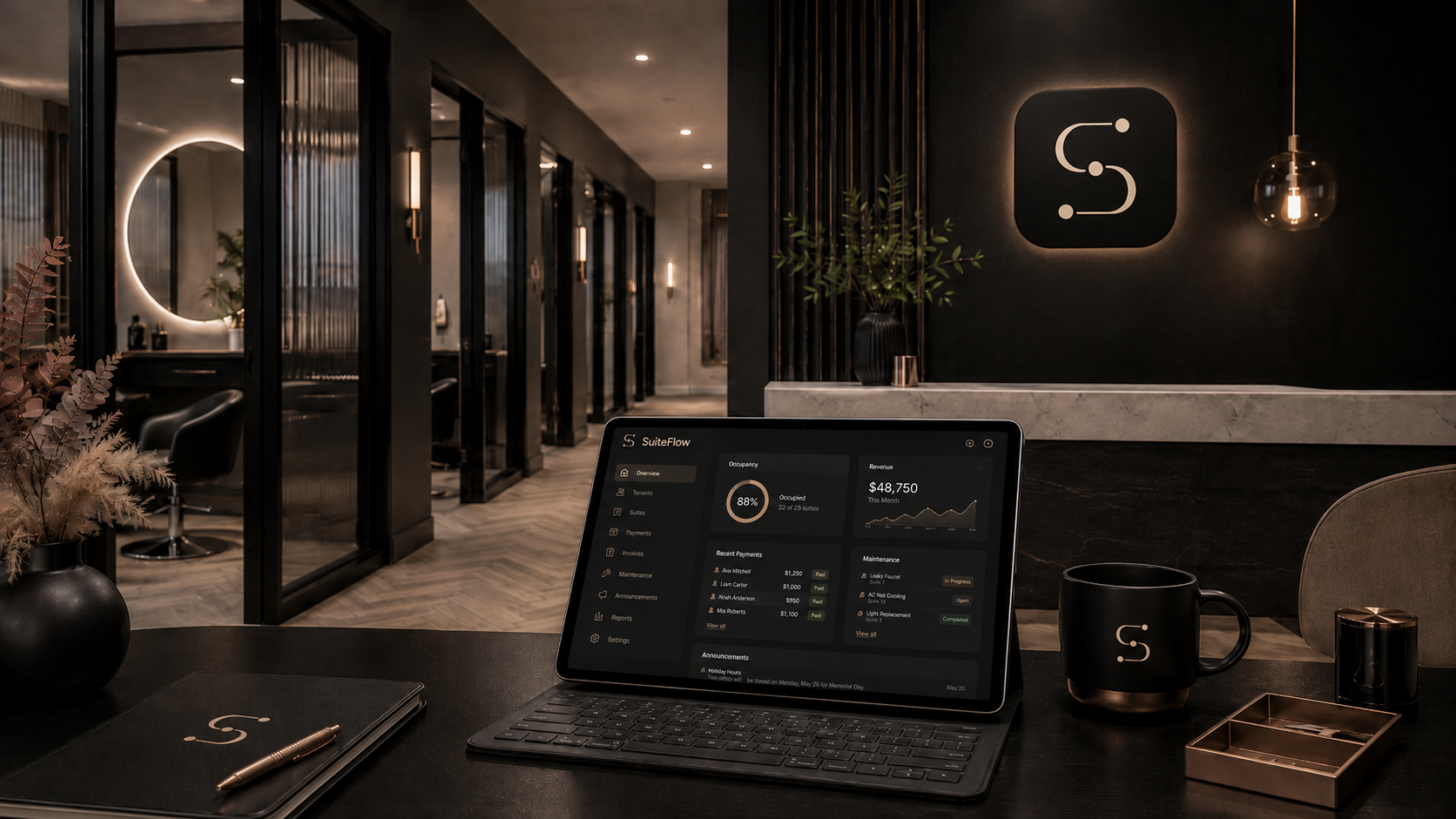
Owners can manage applications, tenants, suites, leases, signatures, payments, invoices, maintenance, communication, documents, and revenue information from one owner portal.
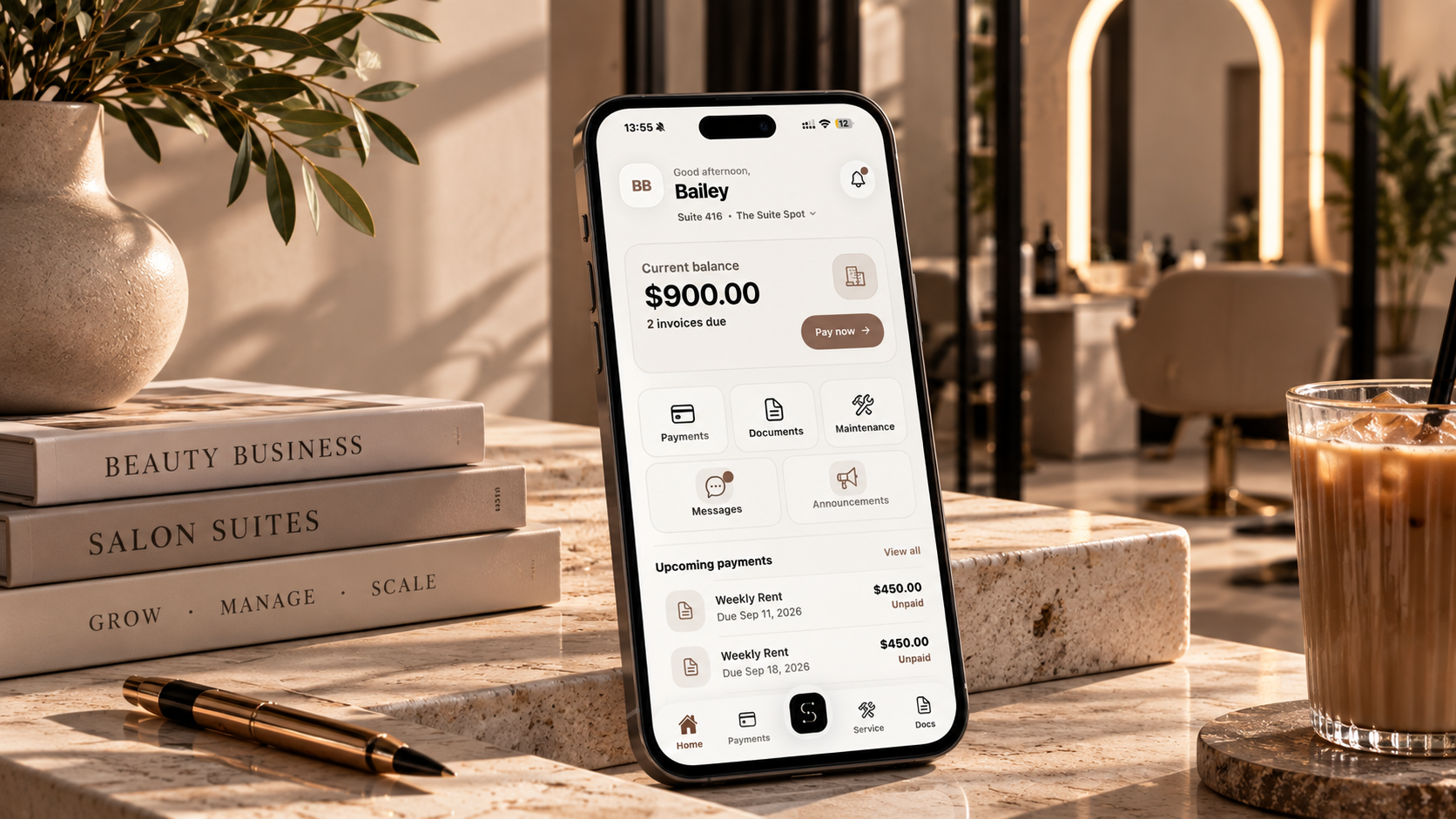
Tenants have their own mobile experience where they can review documents, make payments, submit maintenance requests, receive notifications, and communicate with management.
The goal is simple: give salon suite owners a clearer way to run the business they worked hard to build.
Your Business Should Be Able to Grow Without Becoming Harder to Control
Growth is exciting. More tenants, more suites, and more locations can mean more revenue and a stronger business.
But growth also exposes every weak process.
A system that works only because you personally remember everything will become harder to maintain as the business expands. The solution is not to work longer hours. It is to build better structure.
Salon suite management should give owners more visibility, not more confusion. It should make the tenant experience more professional, not more distant. And it should make growth feel possible without requiring the owner to be available every minute of the day.
Your business should be able to run because you built strong systems—not because you never stop working.
Ready to Manage Your Salon Suites With Less Chaos?
Bring your tenants, suites, payments, leases, maintenance, and communication together in one organized platform.
Explore SuiteFlow and start your 30-day free trial
Frequently Asked Questions
What is salon suite management?
Salon suite management is the process of managing the tenants, rental spaces, payments, agreements, maintenance, communication, and business information involved in operating a salon suite property.
What is salon suite management software?
Salon suite management software helps owners organize their suites and tenants in one system. It may include tools for applications, leases, rent tracking, payments, maintenance, announcements, documents, and reporting.
Is salon suite software different from salon booking software?
Yes. Booking software helps beauty professionals manage appointments and clients. Salon suite software helps property owners manage tenants, rent, suites, agreements, maintenance, and building operations.
How do salon suite owners keep track of rent?
Owners may use spreadsheets, payment apps, bookkeeping software, or a dedicated salon suite management platform. A centralized system is usually easier to manage because it connects payment records to the correct tenant and rental period.
Can SuiteFlow support multiple salon suite locations?
Yes. SuiteFlow allows owners to manage multiple locations from one platform while keeping each property’s tenants, suites, payments, maintenance requests, and revenue information organized separately. Owners can review individual locations or see a complete view of their entire salon suite business.